My house is bigger than yours! How Empty Homes Help Address one of the UK’s Most Persistent Urban Challenges…
Posted on 10 March 2026
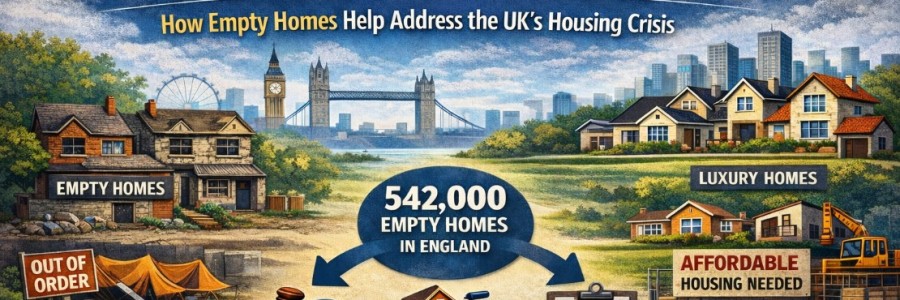
The housing crisis has become one of the most enduring and complex social challenges facing the United Kingdom. While shortages are often discussed in terms of planning delays or rising construction costs, at their core they are deeply intertwined with social inequality. Access to secure, affordable and decent housing is unevenly distributed across society, shaped by wealth, income, socioeconomic background and geography. Housing tenure is a strong indicator of inequality; individuals who own their homes outright typically benefit from long term security, asset accumulation and protection from rent inflation, while those reliant on social housing and the private rented sector face cost burdens.
At the same time, despite a well-documented shortage of
homes, hundreds of thousands of properties across England remain empty. The
scale causes and consequences of empty homes reveal inefficiencies in the
housing system. While empty homes alone cannot solve the housing crisis,
bringing them back into use could play a meaningful role in reducing inequality
and easing pressure on the housing market.
The Structural Roots
of the Housing Crisis
A general lack of housing supply remains the dominant factor
fuelling the housing crisis. The UK government estimates that around 300,000
new homes are needed each year to meet the increasing demand, yet this target
has consistently been missed. Demand pressures have intensified over time due
to population growth, alongside sustained levels of immigration and ongoing improvements
in healthcare technology and medicine. With land being a finite resource,
especially in urban environments, competition for housing has grown
drastically.
From an economic standpoint, constrained supply interacts
with relatively inelastic demand for housing. Shelter is a need rather than a
luxury, meaning that even if supply levels push up prices, demand will not fall
significantly. When supply fails to expand in line with demand, prices then become
pushed beyond the reach of lower income households.
In rural and costal areas, second homes and holiday lets are
often blamed for exacerbating shortages. While they do remove properties from
permanent residential use, it is important to consider that many second homes are
not affordable for low-income household to begin with. Therefore, they are not
necessarily substitutable for the homes most needed within society, empty homes
however, present a different issue; they are part of the existing housing stock
yet contribute nothing to meeting current demand levels.
The Scale of Empty Homes in England
Recent data highlights the significant number of underutilised
properties. In 2025, England recorded over 542,000 empty homes, an increase of
nearly 8% from 2024. When second homes and properties exempt from occupation
are included, more then 1.02 million dwellings are not used as permanent
residences. This equates to roughly 3.96% of the total housing stock.
Of particular concern are long term homes, defined as
properties vacant for more then six months. In 2025, approximately 309,856 homes
fell into this category. Historical data from local authorities and housing
charities shows that these numbers have been rising steadily over successive years,
indicating a persistent issue rather than a temporary fluctuation. Government
taxbase data from 2022 already showed that around 676,000 empty homes, with
248,000 classed as long term vacant, suggesting that the trend has been
worsening.
These statistics prove that there is a substantial pool of
potential housing supply that sits idle while affordability worsens and
homelessness rises.
Empty Homes and the Housing Shortage
Often referred to as ‘wasted housing stock’ this
characteristic is grounded in stark realities. Hundreds of thousands are
currently living in temporary accommodation and local authority waiting lists
for social housing remains exceptionally long. Councils collectively spend vast
sums addressing homelessness. In one year, spending on temporary accommodation reached
approximately £1.2 billion nationally.
Campaigners argue that a coordinated national strategy to
bring empty homes back into use could alleviate pressure quicker than relying
solely on new builds, which can be slow, expensive and less sustainable than
making use of existing structures. However, not all empty homes are immediately
usable. Some are vacant due to probate disputes, ongoing renovations or
seasonal patterns of use. Other vacant homes may require extensive repairs to
meet habitable standards. Nevertheless, even a fraction of a long-term vacant
home is brought back into use, the impact on supply could provide a great
impact.
Social and Economic Consequences of Empty Homes
Beyond the missed opportunities, empty homes actively
generate social costs. Numerous local and national reports link long term vacant
properties to neighbourhood blight and anti-social behaviour. Empty homes can
attract vandalism, fly tipping and pest infestations. Overgrown gardens boarded
up windows and visibly deteriorating facades contribute to a sense of neglect,
which can reduce residents’ perceptions of safety and community pride in that
region.
Properties left unoccupied tend to decay faster due to a
lack of heating, ventilation and routine maintenance. This leads to rising repair
costs, increased risks of damp and structural damage and higher insurance
premiums. Over time it is possible that these homes can be classed as
economically unviable. The coexistence of homelessness spending and high vacancy
rates on a national scale represents a fundamental failure in the housing system
in the UK.
Affordability, Rent and Market Pressure
Affordability remains one of the clearest indications of
housing inequality. In England, tenants now spend an average of 36.3% of their
income on rent, well above the accepted 30% affordability threshold. This statistic
emphasises how housing costs are crowding out spending on other essentials such
as food and transport.
Limited Supply is a central driver of these pressures. When fewer
homes are available to rent or buy, competition intensifies, pushing prices
upward. Empty properties that remain unused effectively tighten supply further,
exacerbating affordability problems. While converting empty homes into
affordable units would not eliminate these pressures entirely, it could help
reduce competition at the margins, particularly in areas with significant shortages.
Many local authorities have introduced council tax premiums to
discourage long term vacancy. For example, Brighton & Hove charges a 100%
council tax premium after one year of vacancy, increasing the longer a property
remains empty. Such measures are designed to shift the cost benefit calculation
for owners, making prolonged vacancy less attractive.
Policy Tools and Persistent Barriers
Local councils possess a range of tools to address empty homes.
These include council tax premiums, empty dwelling management orders and grants
or VAT reductions to support renovation. In theory, these mechanisms provide a
framework for bringing homes back into use.
In practice, however, significant barriers remain. Many
local councils lack the financial and staffing resources needed to proactively
identify, acquire and refurbish empty properties. Some owners lack the funds to
undertake necessary repairs, wile others hold properties vacant for speculative
reasons, anticipating future price rises.
Empty Homes as part of a Broader Solution
Empty homes are not a miraculous solution for the housing
crisis in the UK, nor can they eliminate social inequality in housing. However,
the scale of long-term vacancy represents a significant underutilised resource,
at a time when affordability is worsening, homelessness costs are soaring, and
new housing delivery remains slow, ignoring this resource is getting harder to
justify.
Addressing empty homes requires coordinated policy, adequate
local authority resources and backing and a recognition that housing is not
only a market commodity but also a social necessity.
Other Articles
Know What a Site is Worth
Estimate the development value of any site in seconds with our Land Appraisal Calculator, used by developers across the UK.
Try the calculator